
The Divine Feminine Isnt the Opposite of Toxic Masculinity
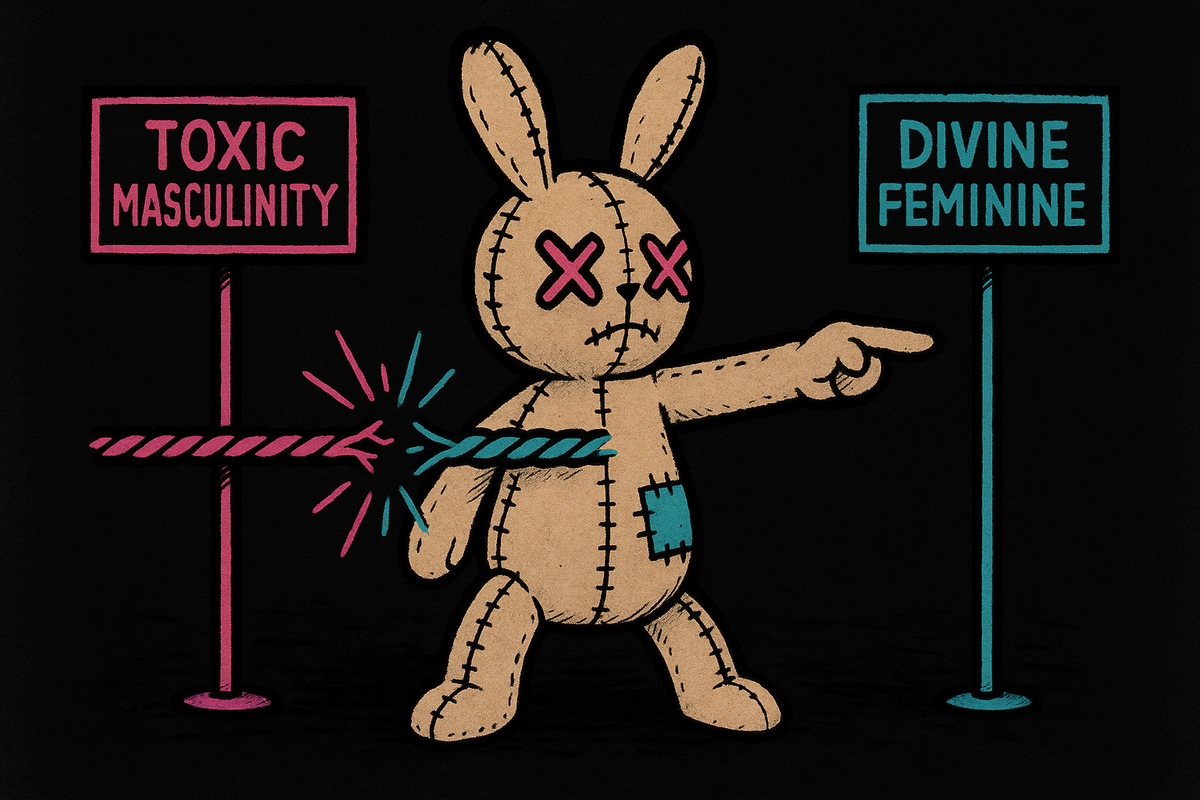
Framing the divine feminine as the opposite of toxic masculinity makes both concepts less useful. They're not a binary — and the real conversation is harder than that.

Part 7 of 9 in the Toxic Masculinity in 2026: A Field Guide series.
We've spent six articles roasting men. Dick pics. Looksmaxxers. Fake doms. Sigma cope. Incels. Trad husbands.
Time for some balance.
Not because men don't deserve roasting—they do, the specimens we've examined are genuinely problematic. But because "men bad, women good" isn't analysis. It's catharsis. And catharsis without balance becomes its own kind of dysfunction.
So let's talk about the divine feminine industrial complex.
The Pitch
The divine feminine is a real concept with real spiritual traditions behind it. The feminine principle. Receptivity, intuition, creation, nurturing. Present in Hindu tantra, Jungian psychology, various goddess traditions. It's not fake.
The divine feminine industrial complex is what happened when this concept met Instagram.
Now the divine feminine is essential oils and manifestation workshops. Moon circles and womb healing. A consumer identity for women who want spirituality pre-packaged and aesthetically coherent.
There's nothing wrong with ritual. Nothing wrong with women's spaces. Nothing wrong with exploring feminine archetypes.
The problem is when "divine feminine" becomes a personality substitute. When the aesthetic replaces the substance. When every criticism can be deflected with "you just don't understand feminine energy."
Sound familiar? It's the same structure as toxic masculinity—an identity that insulates itself from critique by framing critique as ignorance.
The False Binary
The discourse presents toxic masculinity and divine feminine as opposites. Toxic masculinity is the problem; divine feminine is the solution. Men need to heal their toxic patterns; women need to embody their feminine essence.
This is too clean.
Toxic masculinity describes certain patterns: dominance-seeking, emotional suppression, violence as conflict resolution, treating women as objects. Real patterns, real problems.
Divine feminine doesn't describe the opposite of these patterns. It describes a spiritual archetype that can be embodied well or poorly, authentically or performatively, helpfully or as another kind of identity trap.
The actual opposite of toxic masculinity isn't divine femininity—it's healthy masculinity. Which looks like: emotional literacy, secure attachment, collaborative rather than dominance-based relating, accountability without fragility.
Divine feminine is its own thing. Healthy masculinity is its own thing. Treating them as opposites on a spectrum misunderstands both.
The Bypass
Spiritual bypass is when spiritual concepts are used to avoid psychological work. Can't process anger? "I'm just focused on love and light." Won't set boundaries? "I'm practicing radical acceptance." Can't tolerate conflict? "I'm above drama."
The term comes from psychologist John Welwood, who observed how people use spiritual ideas to sidestep emotional development. The spiritual framework becomes a way to avoid dealing with difficult feelings, unprocessed trauma, or challenging relational dynamics. It's not that the spiritual concepts are wrong—it's that they're being deployed to avoid integration work.
The divine feminine industrial complex is ripe for bypass.
Can't articulate what she wants? "Feminine energy is receptive." Won't take responsibility for outcomes? "I'm surrendering to the universe." Avoids difficult conversations? "I'm holding space, not forcing."
The vocabulary provides endless ways to spiritualize avoidance. Every failure to show up can be reframed as honoring feminine energy. Direct communication becomes "too masculine." Setting clear boundaries becomes "not flowing." Accountability becomes "attached to outcomes rather than trusting the process."
This creates relationships where nothing can be named. He does something that bothers her. She doesn't say anything because saying something would be "forcing" or "masculine energy" or "not honoring the flow." The resentment builds. Eventually it explodes. And somehow this is framed as authentic feminine expression rather than the predictable result of avoiding necessary communication.
The spiritual framework makes avoidance sound noble. Radical acceptance sounds better than "I can't tolerate feeling uncomfortable enough to have the conversation." Surrendering to the universe sounds better than "I don't want to take responsibility for my choices." Holding space sounds better than "I'm conflict-avoidant."
This isn't all women who engage with divine feminine concepts. But it's enough that the pattern is recognizable. The spiritual framework becoming a way to not do the work.
And the communities rarely call this out. Because calling it out would require judgment, and judgment isn't very divine feminine. So the bypass continues. The woman who never sets boundaries gets validated for her receptivity. The woman who never articulates desires gets validated for her surrender. The woman who avoids all conflict gets validated for being above drama.
Meanwhile the actual work—developing clear communication, taking responsibility, learning to tolerate discomfort, building capacity for healthy conflict—doesn't happen. The spiritual vocabulary substitutes for psychological development. The aesthetic of growth replaces actual growth.
The Consumption
The divine feminine as consumer category is worth billions.
Crystals. Oracle decks. Moon calendars. Cacao ceremonies. Womb healing retreats. Feminine embodiment courses. The aesthetic is coherent and the products are endless.
Again: there's nothing inherently wrong with any of this. Ritual objects can serve real purpose. Retreats can be valuable. Products can support genuine practice.
The question is whether the consumption substitutes for the practice.
Buying a crystal doesn't heal trauma. Attending a retreat doesn't replace ongoing integration. The aesthetic of spirituality isn't the same as spiritual development.
The divine feminine industrial complex makes money by selling women the appearance of spiritual practice. The appearance can become the endpoint—the aesthetic as identity, rather than the practice as transformation.
The Essentialism
"Women are naturally more intuitive." "The feminine is inherently nurturing." "Women embody receptivity as their essence."
This is essentialism. It maps characteristics onto biology. All women are like this because they're women. The feminine is this because that's what feminine means.
Essentialism causes problems.
Women who aren't intuitive feel broken. Women who aren't nurturing feel unfeminine. Women who are direct and assertive feel like they're betraying their essence. Women who are driven, competitive, ambitious—qualities traditionally coded masculine—now have to reconcile those traits with being told their feminine essence is receptive and yielding.
The divine feminine framework, when it becomes essentialist, creates new boxes for women to fit themselves into. Different boxes than traditional femininity, but boxes nonetheless.
Traditional femininity said: women should be nurturing, receptive, gentle, supportive. Feminism said: women can be anything. The divine feminine returns and says: women's true essence is nurturing, receptive, gentle, supportive—but now it's spiritual rather than social, empowering rather than constraining.
The constraint remains. The woman who doesn't fit the archetype now has two options: suppress her actual personality to fit the framework, or decide she's not properly embodying her feminine essence and work to become more receptive/intuitive/nurturing.
Neither option is liberating. Both are ways of saying "your natural personality is wrong; here's what you should be instead."
Some women are intuitive and receptive. Some aren't. Both are fine. Some women are nurturing. Some are ambitious and competitive. Some are both at different times. Some are neither. All of this is fine. Personality doesn't reduce to gender. Mapping spiritual archetypes onto biology as destiny isn't liberation—it's new constraint dressed in goddess language.
The irony is thick. The divine feminine is supposed to be about reclaiming what patriarchy suppressed. But essentialist versions of it end up reinforcing the same gender boxes patriarchy created—just with better marketing and crystal grids.
A woman who's direct, assertive, competitive, analytical—these aren't masculine traits contaminating her feminine essence. They're just traits. Some women have them. Some don't. Gender doesn't determine personality. Pretending it does, even with spiritual vocabulary, is the same essentialism that feminism spent decades fighting.
The Accountability Dodge
Here's where it gets uncomfortable:
When a man is called out for behavior, accountability is expected. "That was wrong. I'll do better."
When accountability-dodging occurs, it's named. "He's deflecting. He's making excuses. He's refusing to take responsibility."
When a woman in divine feminine framing is called out, the deflection can look like spirituality.
"You're projecting your shadow." "I was in my feminine and that triggered you." "I'm not responsible for your emotional reaction."
These aren't always deflections. Sometimes they're accurate. The person calling out behavior is projecting sometimes. The reaction is the other person's to own sometimes.
But sometimes it's dodge. The vocabulary of feminine spirituality providing cover for avoiding accountability.
If toxic masculinity includes refusing accountability through aggression, there's a feminine equivalent: refusing accountability through spiritual framing.
Both are problems. We name one and often excuse the other.
What We're Not Saying
We're not saying:
- Divine feminine concepts are fake
- Women's spirituality is a scam
- Feminine energy isn't real
- Women are as bad as men
We're saying:
- The divine feminine industrial complex has its own dysfunction
- Spiritual frameworks can be used for bypass
- Essentialism constrains regardless of gender
- Accountability is expected of everyone
The roast we gave men was deserved. This isn't whataboutism—it's completion. The picture isn't complete if we only examine one side.
The Real Work
Healthy femininity—like healthy masculinity—doesn't need an industrial complex.
It looks like: secure attachment, emotional literacy, capacity for both receptivity and assertion, accountability when wrong, clear boundaries, honest communication.
These aren't gendered traits. They're adult traits. They're what psychological development produces regardless of gender. The person who's done the integration work can be receptive when receptivity serves, assertive when assertion serves, nurturing when nurturing serves, boundaried when boundaries serve.
The capacity to flexibly deploy different modes based on what the situation requires—that's maturity. Not feminine, not masculine. Mature.
The division into masculine and feminine principles might be useful as archetype but becomes limiting as prescription. Archetypes can be maps for exploration. Jung used masculine and feminine archetypes to describe different psychological principles—anima and animus, receptive and assertive modes. But Jung understood these as present in all people, not determined by biological sex.
The divine feminine industrial complex takes the archetype and maps it back onto biology. Women should embody the feminine principle. Men should embody the masculine. This isn't Jungian psychology—it's gender essentialism with a spiritual gloss.
A woman can be direct without betraying femininity. A man can be receptive without losing masculinity. The boxes are optional. Or should be. But essentialist frameworks make them mandatory again, just with new vocabulary.
The divine feminine can be a genuine spiritual exploration. Women engaging with goddess traditions, exploring feminine archetypes, building women's communities, creating ritual around female experiences—none of this is inherently problematic. It becomes problematic when it essentializes, bypasses, or becomes consumption.
It can also be a consumer identity that substitutes aesthetic for development. The woman who has crystals and moon calendars and oracle decks but hasn't done any shadow work. The woman who posts about divine feminine energy but can't set a boundary or name what she wants. The aesthetic of spirituality replacing the work of spirituality.
Same with traditional masculinity. Same with any framework. The question is always: is this serving growth, or insulating from it?
If the framework helps you develop capacity—emotional, relational, spiritual—it's serving. If the framework gives you vocabulary to avoid development, it's insulating. The divine feminine can go either way. So can any identity container.
The work is the same regardless: develop your capacity. Learn to communicate. Take responsibility. Build secure attachment. Tolerate discomfort. Process emotion without bypassing it. Show up for difficult conversations. Neither masculine nor feminine—adult.
We roasted men for six articles. They deserved it.
Here's the balance. The divine feminine industrial complex has its own failure modes. Spiritual bypass, essentialism, consumption as substitute for practice, accountability dodge through sacred vocabulary.
Both phenomena are real. Neither is the solution to the other.
The work is the same regardless of gender: develop emotional capacity, take accountability, communicate clearly, attach securely. The frameworks might differ. The destination doesn't.
Previous: What Is a Trad Husband? Next: Brene Brown and the Feminization of Therapy