Distributed Truths: CAP's Knife and Eventual Lies
CAP theorem proves systems can't simultaneously guarantee consistency, availability, and partition tolerance. This isn't an engineering problem—it's physics. Design systems that acknowledge trade-offs transparently.

Why distributed systems force trade-offs that feel like bugs but are actually physics
The Impossible Promise
Your boss wants the system to be always available, perfectly consistent, and resilient to any failure. Your architect nods along. Your PM adds it to the requirements doc. Everyone agrees this is reasonable.
It's not reasonable. It's impossible. Not difficult—impossible. As in: proven mathematically impossible in 2002, the same way you can't go faster than light or square a circle. The CAP theorem isn't an engineering limitation we haven't solved yet. It's a constraint on reality itself.
And it doesn't just apply to databases. It applies to any system where information lives in multiple places and needs to stay coordinated. Your organization. Your relationships. Your own mind trying to hold contradictory beliefs. Distributed systems are everywhere, and they all face the same knife.
The Pattern: Pick Two (Actually Pick One)
CAP theorem says a distributed system can provide at most two of three guarantees:
Consistency: Every read receives the most recent write. All nodes see the same data at the same time. No stale reads, no conflicting versions.
Availability: Every request receives a response. The system is always up. No request goes unanswered.
Partition Tolerance: The system continues operating despite network failures between nodes. Messages can be lost or delayed; the system doesn't collapse.
Here's the brutal part: network partitions will happen. In any real distributed system, messages fail, cables get cut, data centers go dark. Partition tolerance isn't optional—it's the weather. Which means the real choice is between Consistency and Availability. You can't have both.
The Mechanism: Why You Can't Cheat Physics
Imagine two database nodes, A and B, both holding your account balance. A network partition splits them—they can't communicate. You try to withdraw money from node A while someone else checks your balance on node B.
If the system chooses consistency: Node A refuses your withdrawal until it can confirm with B. The system blocks. Availability sacrificed. You're staring at a spinner.
If the system chooses availability: Node A processes your withdrawal, Node B reports the old balance. The data is now inconsistent. Two truths exist simultaneously.
No clever engineering eliminates this. You can make the trade-off more nuanced, shift it contextually, hide it behind abstractions. But somewhere in the stack, something is choosing. The question isn't whether to make the trade-off but whether you're making it consciously or accidentally.
The Fallacies That Kill
Peter Deutsch's Eight Fallacies of Distributed Computing read like a murder indictment:
The network is reliable. It isn't.
Latency is zero. It isn't.
Bandwidth is infinite. It isn't.
The network is secure. It isn't.
Topology doesn't change. It does.
There is one administrator. There isn't.
Transport cost is zero. It isn't.
The network is homogeneous. It isn't.
Every production outage you've ever seen traces back to one of these assumptions hiding in someone's code. They assumed reliability where there was none. They assumed consensus where there was divergence.
"Consensus in distributed systems isn't a feature. It's a phase transition that may or may not occur."
The Application: Designing for Trade-offs
Make the trade-off explicit. Every distributed system design meeting should start with: "Are we optimizing for consistency or availability during partition?" If no one can answer, you don't understand your system.
Context matters. Bank balances need consistency—eventual correctness isn't okay when money vanishes. Social media feeds need availability—showing slightly stale data beats showing nothing. Match the trade-off to the domain.
Eventual consistency is a contract, not a guarantee. "Eventually" might mean milliseconds or hours. Know your SLAs. Design your UI for the uncertainty. Tell users when they're seeing potentially stale data instead of pretending you have truth.
Beyond tech: relational consistency. Your org has multiple nodes (people, teams) holding state (information, beliefs). Messages fail (miscommunication). Partitions happen (silos). Every coordination problem you've ever had is CAP playing out in meatspace. Choose consciously: enforce consistency (slower decisions, more alignment) or allow availability (faster action, eventual reconciliation).
The Through-Line
CAP isn't a problem to solve. It's a constraint to navigate. The moment information lives in multiple places, perfect consistency and perfect availability become mutually exclusive under failure. Not because we haven't tried hard enough. Because that's what distribution means.
This is liberating once you accept it. Stop trying to build the impossible system. Start building systems that degrade gracefully, that make their trade-offs visible, that tell you when they're lying about consensus.
Centralization is a crutch—a way to avoid the trade-off by avoiding distribution. It doesn't scale. The only path forward is learning to live with the knife: knowing what you're sacrificing, when, and why.
Substrate: CAP Theorem (Brewer/Gilbert-Lynch), Distributed Systems Theory, Fallacies of Distributed Computing
Attractor Hacking: Phase Shifts in Your Stack
Why systems settle into grooves—and how to shift them without breaking everything
Pillar: SYSTEMS | Type: Pattern Explainer | Read time: 9 min
The Gravity You Can't See
You've tried to change something and it reverted. Pushed the system to a new state, watched it drift back to where it was. The org restructure that's the same org six months later. The habit change that didn't stick. The technical improvement that got eroded by a thousand small decisions until the codebase was back where it started.
The problem wasn't execution. The problem was you pushed against an attractor without changing the attractor itself.
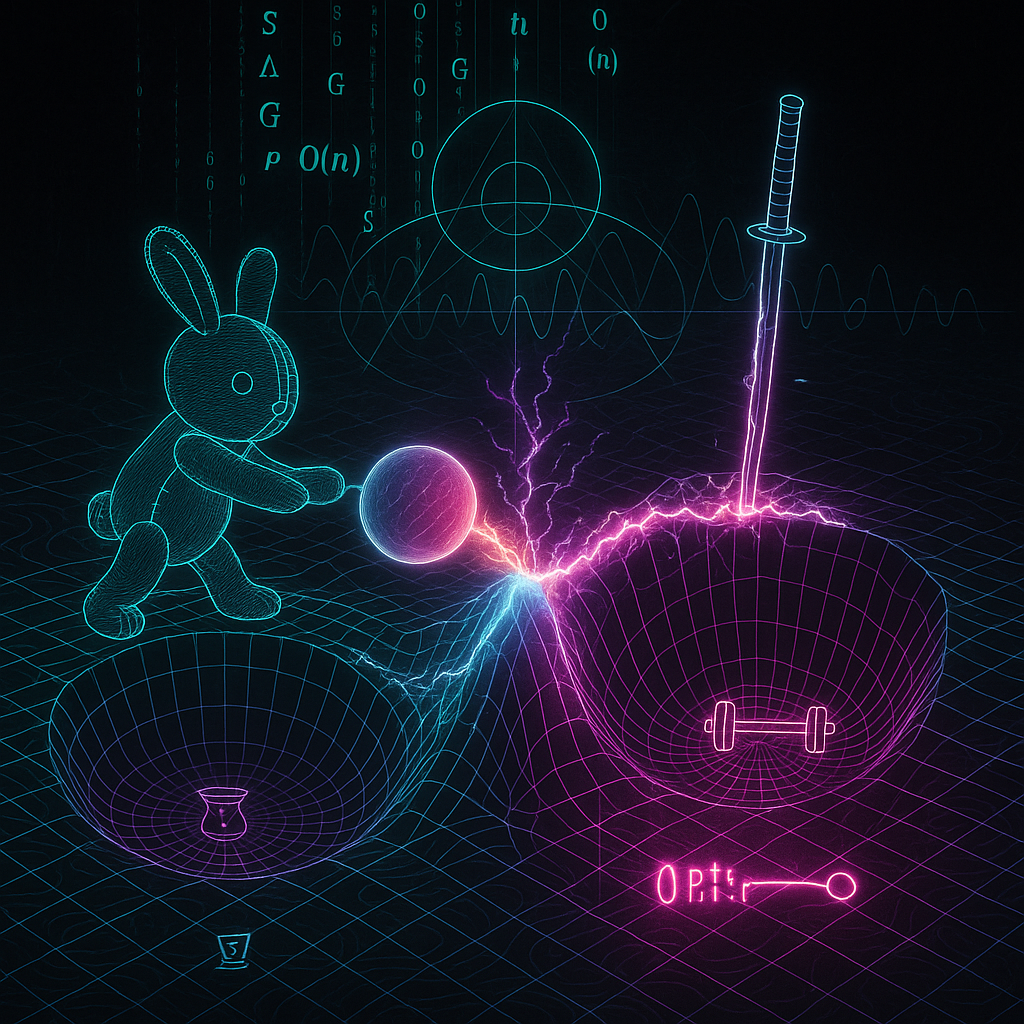
Complex systems have gravity. They settle into patterns—regions of state-space they flow toward and resist leaving. Push them away, they roll back. The only way to create lasting change is to reshape the landscape itself.
The Pattern: Attractors and Basins
Dynamical systems theory gives us the vocabulary. An attractor is a region of state-space the system tends toward. A basin of attraction is the region from which the system flows toward that attractor.
Your codebase has attractors. Certain patterns emerge again and again because they're the path of least resistance given your team's skills, tools, and constraints. Your organization has attractors. Certain meeting patterns, decision processes, and political dynamics reassert themselves because they're stable equilibria given the incentives and people involved.
You can fight an attractor temporarily. You cannot fight it permanently. The only sustainable change is attractor change.
The Mechanism: Phase Transitions and Landscape Reshaping
Phase Transitions
Systems don't always change gradually. Sometimes they flip—rapidly transitioning from one attractor to another. Water doesn't slowly become ice; it undergoes a phase transition at a critical temperature. Markets don't slowly crash; they hit a tipping point and cascade.
Phase transitions are both opportunity and danger. Opportunity: a small push at the right moment can flip the system to a new state. Danger: the system can flip away from where you want it without warning.
The skill is recognizing when a system is near a phase transition—when the attractor landscape is malleable. Change initiatives that fail during stable periods might succeed during moments of instability. The same intervention, different timing, different outcomes.
Landscape Reshaping
If pushing against attractors doesn't work, what does? Changing what the system is attracted to.
Incentives reshape landscapes. Change what's rewarded and you change where the system flows. But be careful—Goodhart's Law means the new incentive will be gamed. Design for what happens after the gaming starts.
Constraints reshape landscapes. Make the undesired state harder to reach. Friction on bad paths, lubrication on good ones. Defaults matter enormously—the path of least resistance is where most traffic flows.
Feedback loops reshape landscapes. Shorten the loop between action and consequence and the system learns faster. Lengthen it and learning slows. Many stuck systems are stuck because feedback is too delayed to shape behavior.
Entrainment as Transition Protocol
Systems synchronize. Rhythms entrain to other rhythms. This is the mechanism beneath rituals, retrospectives, regular check-ins. The rhythm creates a forcing function that keeps the system from drifting.
A weekly retrospective isn't just a meeting. It's an entrainment pulse that pulls the system toward reflection and adaptation. Without it, the system drifts toward whatever local attractors exist—usually entropy.
Change requires sustained rhythm. One push isn't enough. A regular pulse, consistently applied, reshapes attractors over time.
The Application: Hacking Your Attractors
Map the current attractors. Before trying to change anything, understand what the system is currently attracted to. What patterns keep reasserting? What states does the system flow toward despite attempts to change? These are your attractors. Fighting them is futile. Understanding them is prerequisite.
Identify the landscape parameters. What's creating those attractors? Incentives, constraints, defaults, feedback loop lengths. These are the levers. Push on system state, nothing sticks. Push on landscape parameters, and the system moves itself.
Time interventions to instability. Systems are most changeable during phase transition moments—crises, leadership changes, major project launches or endings. The same intervention that fails during stability might succeed during flux. Store your change energy for moments when the landscape is already shifting.
Create entrainment rhythms. Regular pulses that pull the system toward the new attractor. Weekly practices. Daily habits. Monthly reviews. The rhythm does the work of sustained force without requiring sustained attention.
Barbell your change portfolio. Stable core practices you don't mess with (the safe pole). Experimental initiatives that might fail but would reshape attractors if they succeed (the convex pole). Nothing in the middle—no endless "improvements" that consume resources without either maintaining stability or transforming the landscape.
The Through-Line
Systems have gravity. They settle into grooves and resist leaving. Pushing against attractors is exhausting and temporary. The only sustainable change is reshaping the landscape that creates the attractors.
This is slower than heroic intervention. It's also the only thing that actually works. You're not forcing the system anywhere. You're changing what it wants to be, and then it moves itself.
Map the attractors. Find the parameters. Time your interventions. Create sustaining rhythms. And stop fighting gravity when you could be reshaping it.
Substrate: Dynamical Systems Theory, Phase Transitions (econophysics), Entrainment (complexity science)