Craps: The Most Intimidating Table in the Casino (And Why You Should Learn It)

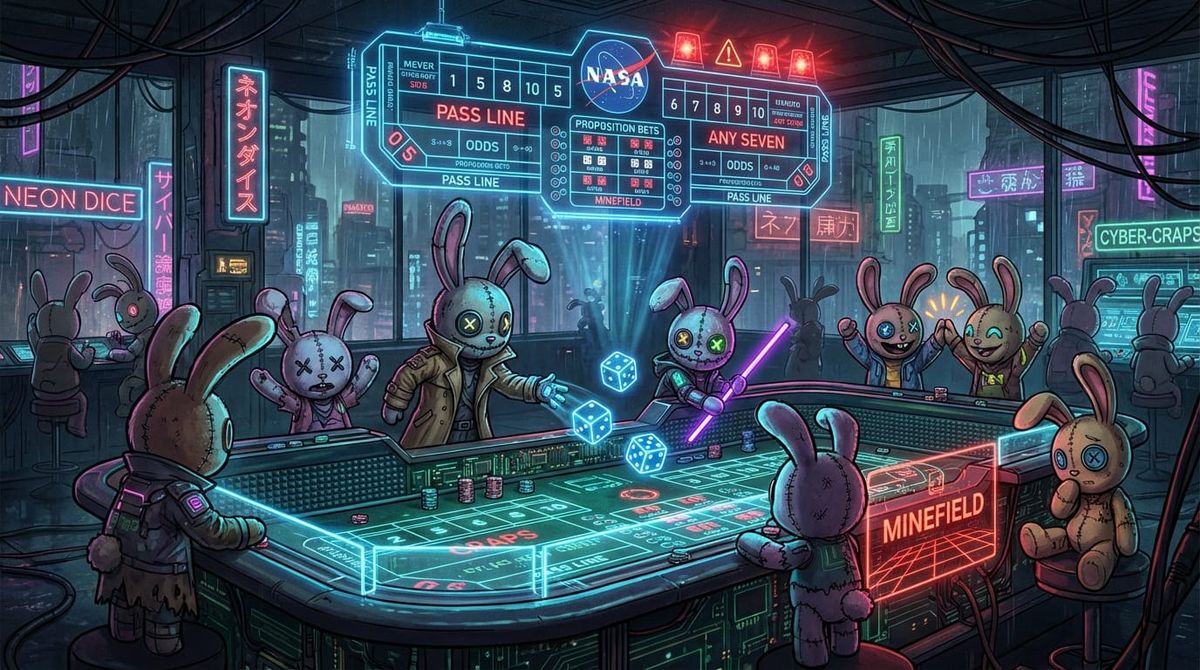
Fourteen people crowded around a table the size of a bathtub, screaming at dice. A felt layout covered in numbers, arrows, circles, and terminology that looks like it was designed by someone who wanted to make sure no newcomer ever felt welcome. A stick person pushing dice around with a hook. Someone yelling “yo eleven” and getting paid. The woman next to you just threw $25 on something called a “hard eight” and you have no idea what that means but she seems extremely excited about it.
This is craps, and it has the best odds on the casino floor. Also the worst odds on the casino floor. Both of these things are true simultaneously, which is the entire trick, and the reason the game prints money for the house despite offering the single fairest bet in the building.
The NASA Control Panel Is a Feature, Not a Bug
The complexity of the craps layout is not an accident. It is, in the most precise sense, a design choice that generates revenue. The casino wants the craps table to look intimidating, because intimidation drives players away from the best bets and toward the worst ones; or away from the table entirely, toward the slot machines and roulette wheels where the math is dramatically worse.
Consider the slot machine. A child could play one. Insert money, press button, wait. The simplicity is the product. No decisions, no confusion, no social anxiety. Also a 5% to 15% house edge, which means the player is paying somewhere between $30 and $90 per hour for that simplicity on a dollar machine. Now consider the craps table. A newcomer sees chaos. They see jargon they don’t understand, money moving in ways they can’t follow, and social dynamics that feel like an inside joke they’re not in on. So they walk to the slots.
The casino just won. Not at the craps table; at the slot machine the player chose instead. The intimidation factor of craps functions as a sorting mechanism. It pushes casual players toward higher-margin games. The players who push through the intimidation and learn the game discover that the core of craps is two bets, maybe three, and everything else on that felt layout is decoration. Expensive, profitable-for-the-house decoration.
Two Bets. That’s It.
The pass line bet is the foundation of craps, and it’s the only bet a smart player needs to understand completely. You place your money on the pass line before a new “come out” roll. If the shooter rolls a 7 or 11, you win even money. If they roll a 2, 3, or 12, you lose. If they roll anything else (4, 5, 6, 8, 9, or 10), that number becomes “the point.” The shooter then keeps rolling until they hit the point again (you win) or roll a 7 (you lose).
The house edge on the pass line is 1.41%. That’s it. No strategy required, no decisions to optimize, no basic strategy chart to memorize. Put your money on the line and let the dice decide. At a $10 table with roughly 120 rolls per hour, your expected cost is about $5 per hour. Compare that to the roulette wheel at $18.50 per hour or the slots at $60. The craps table is already cheaper than almost anything else in the building, and the player hasn’t even gotten to the good part yet.
The come bet is structurally identical to the pass line bet but placed after a point has been established. It creates a new personal point for the come bettor, operating under the same rules: 7 or 11 wins immediately, 2, 3, or 12 loses immediately, anything else becomes the point. Same 1.41% edge. The come bet is how experienced players get multiple bets working simultaneously; each one at the same low house edge, each one generating action and engagement without increasing the mathematical cost proportionally.
The don’t pass and don’t come bets are the mirror images: betting against the shooter. The house edge drops slightly to 1.36%. These are sometimes called “wrong” bets, which is a social judgment, not a mathematical one. Betting don’t pass at a hot table will earn you dirty looks from every other player, because craps is a communal game and most of the table is rooting for the shooter. The math doesn’t care about social dynamics, but the player experience does, and for most people the 0.05% edge improvement isn’t worth the hostility. This is a legitimate choice. Games are supposed to be fun, and fun has a small price sometimes.
The Only Zero-Edge Bet in the Building
After a point is established, the pass line bettor can place an additional “odds” bet behind their original wager. This bet pays at true odds; the actual mathematical probability of the point being made versus a 7 rolling. A point of 6 or 8 pays 6 to 5. A point of 5 or 9 pays 3 to 2. A point of 4 or 10 pays 2 to 1. In every case, the payout corresponds exactly to the probability. There is zero house edge on the odds bet.
This is not marketing. This is not rounding. The odds bet in craps is the only wager in the casino that pays exactly at fair value. The house makes no money on it. It exists because it increases action; it gets more money on the table per roll, and the house still earns its 1.41% on the underlying pass line bet. But for the player, every dollar moved from a proposition bet to the odds bet is a dollar transferred from the house’s column to neutral territory.
The maximum odds bet varies by casino. Some offer 2x odds, meaning you can place twice your pass line bet behind the line. Some offer 5x, 10x, or even 100x. The more odds you can take, the lower the combined house edge on your total action. At 1x odds, the combined edge on pass-plus-odds drops to about 0.85%. At 3x-4x-5x odds (a common configuration), it drops to around 0.37%. At 10x odds, it’s roughly 0.18%. The practical implication is straightforward: the smart craps strategy is to make the minimum pass line bet and take maximum odds behind it. This concentrates your money on the zero-edge bet and minimizes the amount exposed to the 1.41% edge.
That’s the entire strategy. Pass line, minimum bet, max odds. Or come bet, minimum bet, max odds. Repeat. The dollars-per-hour cost at a $10 table with 3x-4x-5x odds, playing one pass line bet with full odds, is roughly $2 to $3 per hour. You will not find a cheaper seat in the casino unless you sit in the lobby and watch people walk by.
Everything Else on the Table Is There to Take Your Money
The proposition bets in the center of the layout; the one-roll bets on specific numbers, the hardways, the field bet, “any craps,” “any seven”; these are the reason the casino offers the pass line at 1.41% and the odds bet at zero. They’re the profit center. They’re where recreational craps players, seduced by the big payouts and the exciting action, give back everything the base game saved them.
Any seven pays 4 to 1 on a one-roll bet. Sounds good until you realize the true odds are 5 to 1, which gives the house a 16.67% edge. That is not a typo. Sixteen percent. On a bet that resolves in one roll. A player making $5 any-seven bets at 120 rolls per hour is paying $100 per hour for the privilege. They are now paying more than the slot machine player, on the game with the best base odds in the casino, because they wandered into the center of the layout.
The hardways (hard 6, hard 8, hard 4, hard 10) carry edges between 9.09% and 11.11%. The field bet, which looks like a reasonable wager because it covers so many numbers, carries a 5.56% edge on most tables. “Yo eleven” at 11.11%. Every one of these bets is a profit extraction tool disguised as an exciting option, and they exist because the psychology of a hot craps table; the screaming, the camaraderie, the infectious energy of a shooter on a run; makes players feel generous with their money. The social pressure to throw some action on the center is real. The cost of that social compliance is also real, and it’s enormous.
Ignore the center. Ignore the proposition bets. Ignore the stick person calling out the exciting payoffs. The layout is a map with a small safe zone (pass, come, odds) surrounded by a minefield, and the minefield is where the casino makes its money on the game.
The Social Architecture Is the Point
Craps is the only casino game where every player at the table is usually rooting for the same outcome. At blackjack, your neighbor’s hand doesn’t affect your emotional state. At craps, when the shooter is trying to make a point, the entire table is invested. Strangers high-five. People who met ten minutes ago are screaming together. The communal energy when a table is hot; when the shooter keeps making points and the chips keep stacking; is unlike anything else on the casino floor.
This is not incidental to the game. This is the game. Craps has survived for decades despite having worse visual presentation, more complexity, and fewer seats than its competitors precisely because the social experience is irreplaceable. The table creates temporary community. Two hours at a hot craps table generates a kind of collective memory that players carry with them; they remember the run, the cheering, the specific rolls. They don’t remember individual hands of blackjack.
For the newcomer, the etiquette matters more than the strategy. Handle the dice with one hand only. Don’t dangle your hands over the table when the shooter is rolling. Don’t say “seven” at the table (superstition, but violating it will genuinely annoy experienced players, and annoying the people you’re standing shoulder-to-shoulder with for three hours is bad policy). When you’re the shooter, hit the back wall with the dice. These aren’t arbitrary rules; they’re the social contract that makes the communal experience work, and respecting them is the price of admission to the best social game in the building.
The bankroll consideration for craps is different than for blackjack or slots because the game is streaky by nature. Long runs of pass-line winners and long runs of sevens-out are both normal. The variance is wide enough that a properly-sized bankroll should be 30 to 50 times your base bet to weather the cold streaks without going broke. At a $10 table, that’s $300 to $500 for a session. This is not the amount you expect to lose; it’s the working capital that keeps you in the game long enough for the math to do its thing. Most of it should come home with you. If it doesn’t, that’s the variance talking, and the variance eventually talks in both directions.
The Intimidation Is the Casino’s Best Trick
The craps table is the cheapest entertainment on the floor. It is the only place in the building where you can make a zero-edge bet. The social experience is unique in an industry that increasingly replaces human interaction with touchscreens. The strategy, stripped of the noise, is two bets and a sizing rule. And most casino visitors never play it, because the table looks like a NASA control panel and nobody wants to look stupid in front of strangers.
That intimidation is the casino’s best trick; better than the free drinks, better than the loyalty cards, better than the carpet designed to keep you walking past the slot machines. Every player who glances at the craps table, feels overwhelmed, and sits down at a roulette wheel instead just paid a 5.26% house edge for the comfort of not having to learn something new. The roulette wheel didn’t earn that player. The craps table’s complexity scared them there.
The fix is simple and boring. Watch for twenty minutes. Stand behind the table, not at it. Watch the pass line bets go out and come back. Watch the odds get placed. Ignore the center. Ignore the jargon you don’t understand; most of it refers to bets you’re never going to make. When the mechanics of pass line and odds are clear, buy in for your session bankroll, place a pass line bet, take maximum odds, and let the game do what the game does. Within thirty minutes, the table that looked incomprehensible will feel intuitive, the players next to you will be rooting for the same thing you’re rooting for, and the entertainment you’re purchasing will cost less per hour than the appetizer you had at dinner.