Consciousness and the Hard Problem: The Most Respectable Unsolved Mystery

Every entry in this series has been leading here. The ghost that infrasound can’t fully explain, the entity contact that the REBUS model accounts for but doesn’t quite close, the simulation argument resting on the premise that consciousness can run on any substrate: all of these threads terminate in the same place. What is consciousness, and why does it exist at all.
This is not a question that neuroscience has answered. That statement requires some unpacking because it sounds like the kind of complaint people make when they’re not paying attention to the field. Neuroscience has answered, or is credibly in the process of answering, a large number of questions about the brain. How does attention work. What circuits are involved in fear. Where is language processed. How does memory consolidate during sleep. These are hard questions in the engineering sense: technically demanding, requiring sophisticated methods, years of careful work. They are what philosopher David Chalmers in 1995 called the “easy problems,” and he meant that descriptor functionally, not dismissively. They are easy in the specific sense that we know what a solution would look like: a mechanistic account, neurons and circuits and neurotransmitters, inputs and outputs and processing steps.
The hard problem is not like this. The hard problem is the question of why any of this processing is accompanied by subjective experience at all. Not how the brain produces behavior in response to sensory input: that’s the easy problem. But why there is something it is like to be a system doing that processing. Why, when photons hit your retina and the visual cortex runs its processing, you experience the redness of red, the specific qualitative character of it, rather than simply responding to red-wavelength information the way a smoke detector responds to smoke. The smoke detector responds to smoke. It doesn’t experience anything. The question is what makes you different, and not at the level of complexity or integration: at the level of why there is any felt quality to what’s happening at all.
Nobody has an answer. Not even close.
Three Major Theories, None of Them Complete
The field has converged on several serious candidates, each with genuine technical sophistication and genuine unresolved problems.
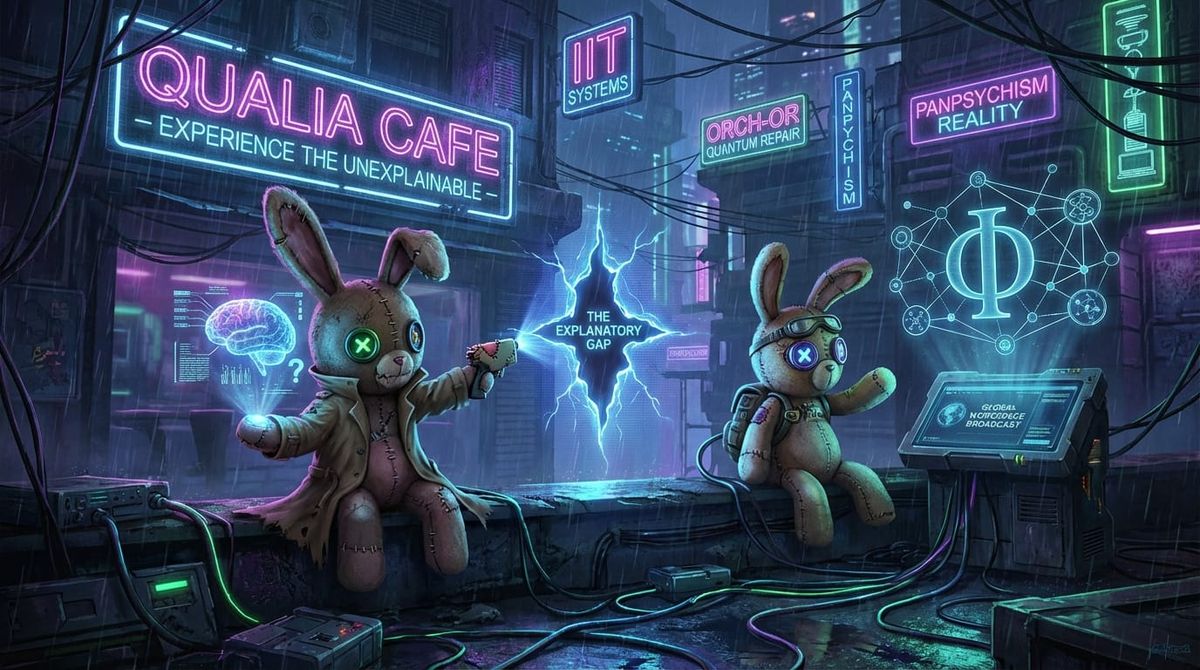
Integrated Information Theory, developed by neuroscientist Giulio Tononi, proposes that consciousness is identical to a specific type of information integration, quantified by a measure called phi. Systems with high phi have rich conscious experience. Systems with low phi have little or none. The appeal of IIT is that it gives you a principled way to assign a consciousness value to any system: calculate phi, you know the degree of consciousness. It also explains why the cerebellum, which has more neurons than the rest of the brain combined but a modular architecture that limits integration, contributes little to conscious experience, while the more highly integrated cerebral cortex is the seat of it.
The problems with IIT are significant. First, phi is computationally intractable: you cannot actually calculate it for a system of any complexity, which limits its predictive utility. Second, IIT predicts that certain simple systems with the right architecture would be conscious, including, in principle, some grid arrays, which strikes many critics as implausible (though Tononi bites this bullet and calls it panpsychism-adjacent, which is its own interesting rabbit hole). Third, and most fundamentally, IIT, like all theories in this space, runs into what is sometimes called the “explanatory gap”: even if phi perfectly predicted which systems report conscious experience, it would not explain why phi gives rise to felt experience rather than simply to information processing without any accompanying phenomenology. The correlation, if established, would still need explanation.
Global Workspace Theory, associated primarily with Bernard Baars and more recently with Stanislas Dehaene, takes a different approach. Consciousness arises when information is broadcast widely across a “global workspace,” a large-scale neural architecture that makes information simultaneously available to many cognitive processes. The “ignition” that occurs when this broadcast happens is, on GWT, what it means for information to enter consciousness. GWT is probably the most empirically productive framework currently running: it generates testable predictions about neural correlates of consciousness, it explains why anesthesia works the way it does, it fits the data on attention and unconscious processing reasonably well.
The problem is the same problem. GWT tells you about access consciousness: which information is available to the system for report, reasoning, and behavioral control. It does not tell you about phenomenal consciousness: why there is any felt quality to the information being accessed. Ned Block’s distinction between these two types of consciousness is exactly the right scalpel here. You can have a complete account of access consciousness, which GWT may be close to providing, and still have said nothing about phenomenal consciousness. The hard problem survives GWT intact.
Orchestrated Objective Reduction, the Penrose-Hameroff theory, is the most controversial of the three and requires the most tolerance for radical hypothesis. Roger Penrose, a mathematician and physicist who won the Nobel Prize for his work on black holes, has argued since the 1980s that human consciousness cannot be fully accounted for by any computational system, on the grounds that human mathematical insight appears to transcend what Godel’s incompleteness theorems say any formal system can achieve. If consciousness is not computational, something non-computational must be producing it. Penrose’s candidate: quantum gravitational effects, specifically the collapse of quantum superposition in a way that is not reducible to standard quantum mechanics, happening in microtubule structures inside neurons.
Anesthesiologist Stuart Hameroff provides the biology half of this: microtubules, the structural proteins inside neurons, have properties that might support quantum coherence, though maintaining coherence in the warm wet environment of a cell at human body temperature is deeply challenging. The theory is specific enough to generate predictions, and some research on microtubule quantum effects has produced results that are more interesting than expected. But Orch-OR remains well outside the mainstream. Most neuroscientists regard the quantum mechanics as unnecessary machinery: why invoke quantum gravity when simpler mechanisms might account for the same phenomena. The counterargument, which is Penrose’s point, is that simpler mechanisms will not close the explanatory gap either. If the hard problem is real, you need something genuinely new.
Why the Hard Problem Is a Structural Mystery, Not a Gap
The distinction between a gap in knowledge and a structural mystery matters. A gap in knowledge is a question we don’t yet have the answer to but which we expect to answer with more research and better tools. We didn’t know the structure of DNA until we did. We didn’t understand protein folding until AlphaFold. These are gaps: we could specify what an answer would look like, and we found one.
The hard problem is different because we cannot specify what an answer would look like. Any mechanistic account of brain processes, no matter how complete, faces the same question: why does this processing produce felt experience. You can add more neurons, more circuits, more integration, more information broadcast, and the question persists unchanged. The gap doesn’t close as the mechanism gets more detailed. It remains exactly the same gap regardless of the level of mechanistic detail. That’s what makes it structural: it’s not that we need more data, it’s that the type of explanation we’re reaching for doesn’t have the shape to fit the question.
This is why some philosophers have taken seriously positions that most scientists regard as extreme. Panpsychism, the view that consciousness is a fundamental feature of the universe rather than something that emerges from complex physical systems, is enjoying an academic revival partly because the hard problem seems to resist emergence-based solutions. If consciousness cannot be explained by the right arrangement of non-conscious parts, then maybe consciousness is present, in some primitive form, at every level of physical reality, and the brains of animals are just the arrangements in which it becomes sufficiently organized to be the kind of experience we recognize as experience. This is the view of philosophers like Philip Goff and David Chalmers himself (in his more speculative moments). It is not a popular view. It is a live view, held by serious people, for defensible reasons.
The trouble with panpsychism is the “combination problem”: how do small proto-conscious elements combine into the unified, rich subjective experience of a human mind? You can posit that electrons have some microscopic form of experience without being anywhere near an explanation of how billions of those tiny proto-experiences combine into the single continuous experience of being you. Critics argue this is just the hard problem restated at a different level rather than solved. Defenders of panpsychism acknowledge the combination problem is real but argue it is at least a more tractable version of the hard problem than the standard emergence account faces, because at least it doesn’t require consciousness to appear ex nihilo from wholly non-conscious matter. The debate is ongoing, serious, and entirely unresolved.
Illusionism, the view associated with philosopher Keith Frankish and supported by Daniel Dennett, takes the opposite approach: deny that phenomenal consciousness, in the hard-problem sense, exists at all. What we call subjective experience is an introspective illusion: the brain generates representations of itself as having rich inner experience, but the “what it is like” quality is a cognitive construction, not a genuine explanandum. This view is elegant, controversial, and strikes many philosophers as dodging the question rather than answering it. As Thomas Nagel pointed out: even if the felt quality is an “illusion,” there is still something it is like to have the illusion. The experience of being deceived is still experience. Illusionism has serious defenders and serious critics. It has not solved the hard problem. It has argued the hard problem is wrongly framed. Whether that’s the same thing is itself a hard problem.
What This Means for Everything That Came Before
The series has been building toward this point because the hard problem of consciousness is the foundation on which every other question in this guide rests. If we knew what consciousness was, we could say more definitively whether ghosts could exist. If we knew whether consciousness is substrate-independent, Bostrom’s simulation argument would be easier to evaluate. If we understood what the prediction machinery is doing when it generates DMT entities, we’d have a clearer view on the ontological question.
We don’t know any of this. The hard problem is not being solved. The three main theories are sophisticated, productive, and none of them close the gap. IIT cannot make phi tractable. Global Workspace Theory has nothing to say about phenomenal experience. Orch-OR requires physics that hasn’t been established. Meanwhile, the neuroscience of consciousness marches forward: we can measure neural correlates of conscious states with increasing precision, we can describe the brain dynamics of anesthesia and sleep and dreaming in remarkable detail, we can identify where things go wrong in consciousness disorders like vegetative state and unresponsive wakefulness. All of this is real progress. None of it touches the hard problem.
The correct response to this state of knowledge is not mysticism, and it is not the dismissive confidence that “consciousness is obviously just brain activity, get over it.” The correct response is rigor applied to genuine uncertainty: we have a real phenomenon, subjective experience, that we cannot explain in physical terms, not because we lack the right data but because we lack the right conceptual framework. We’re in the position of someone trying to explain color with only a tactile vocabulary. The limitation isn’t the data. It’s the concepts.
This entry rates Gold, and not because the hard problem has been solved. Gold because it is the most legitimate unsolved scientific and philosophical question in existence, the one with the most serious researchers, the most prestigious journals, the most explicit acknowledgment from major figures in neuroscience and philosophy that the problem is real and they are not close to solving it. The tin foil hat crowd thinks the cover-up is about UFOs or elite pedophile rings. The actual cover-up, if you want to call it that, is that the most fundamental question about the nature of mind and experience is not close to resolution, and most popular science communication presents a picture of consciousness that is significantly more settled than the actual state of the field.
There is something it is like to read this. You are having an experience right now. What that experience is, where it comes from, and whether it has any existence independent of the physical system generating it: nobody knows. That’s not poetry. That’s the field report.