Four Blind Men and a Jumbo Jet Full of Human Knowledge
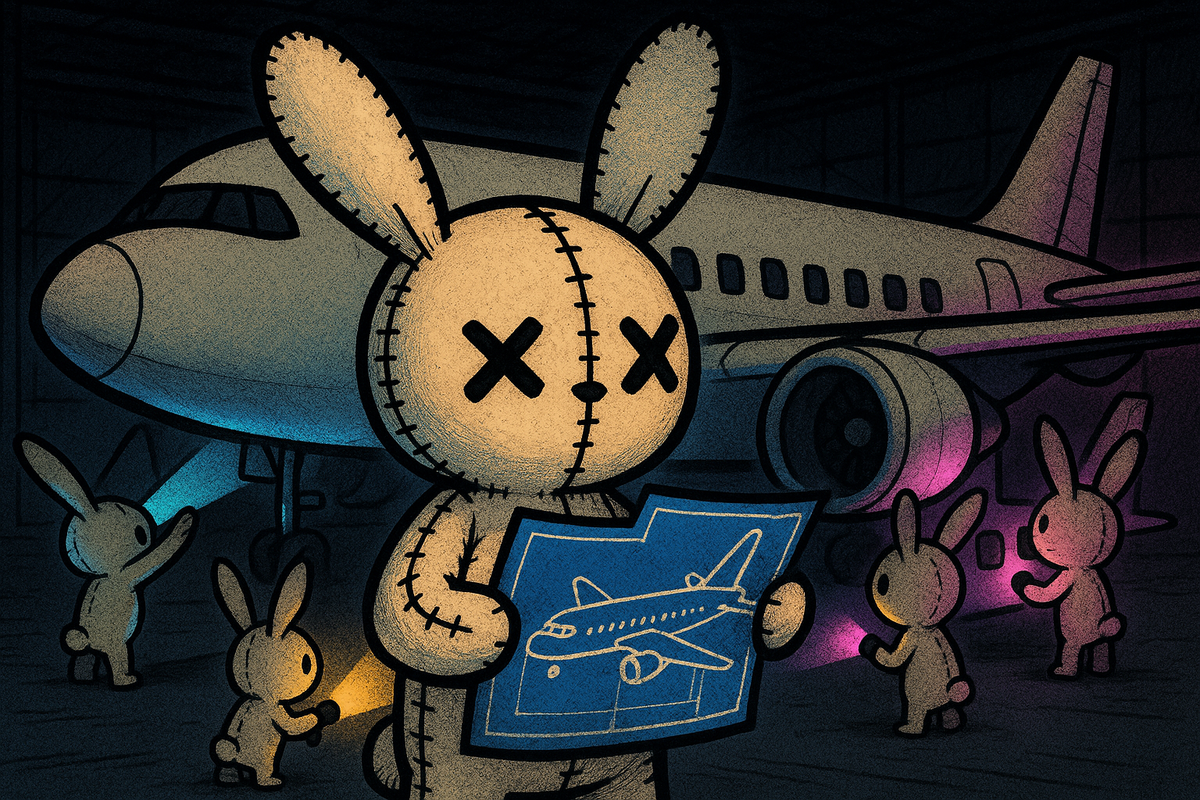
Same parable, bigger problem: the elephant is now a 747 containing the entire corpus of human knowledge. Perspective limits didn't disappear — they just got much harder to see.
Part 6 of 25 in the The Philosophy of Future Inevitability series.
You know the parable.
Four blind men encounter an elephant. One touches the leg and says "it's a tree trunk." One touches the tail and says "it's a rope." One touches the side and says "it's a wall." One touches the tusk and says "it's a spear."
Each is right about his part. All are wrong about the whole.
Now update the parable: the elephant is a 747 containing the entire corpus of human knowledge.
The Old Limitation
Before AI, we were all blind men.
Not literally. But cognitively. Humans have limits:
Memory limits. You can't hold more than a few things in working memory. You can't recall everything you've ever learned. Most of what you've read is gone—a vague sense that you once knew it.
Attention limits. You can only focus on one thing at a time. Every question you pursue means a thousand questions you don't. Every domain you master means domains you never enter.
Perspective limits. You see from where you stand. Your training, your culture, your experiences—all shape what you can perceive. Blind spots aren't exceptions; they're the default.
Time limits. You have one lifespan. You can learn for decades and still only scratch surfaces. The knowledge exists. You don't have time to acquire it.
We developed specialization to cope. You learn one thing deeply. Others learn other things. Together, maybe, we cover the elephant.
But no individual could hold the whole. No person could see the 747.
This created a certain kind of genius. The person who mastered multiple domains became exceptional by definition. Leonardo da Vinci knew art, engineering, anatomy. Darwin knew geology, biology, breeding. Einstein knew physics and philosophy. These people were rare because the cognitive load of true interdisciplinary mastery was immense.
Most people couldn't do it. Most people specialized. And specialization created its own blindness—you knew your domain so deeply that you couldn't see beyond its borders. The physicist who doesn't know biology. The biologist who doesn't know math. The mathematician who doesn't know history.
Each expert touched their part of the elephant with exquisite precision. None could tell you what the whole animal was shaped like.
The collaboration that tried to bridge this—interdisciplinary teams, cross-functional work—was always hampered by translation costs. The physicist and the biologist speak different languages. They use the same words to mean different things. They have different standards of proof. Getting them to actually collaborate requires enormous effort just to establish shared vocabulary.
Most of the time, the effort was too high. People stayed in their silos. The elephant remained un-integrated.
The New Capacity
AI can hold the whole.
Not perfectly. Not without error. But qualitatively differently than humans.
An LLM has ingested... most of it. Most of recorded human knowledge. The corpus of text that represents what we've figured out. Science, history, philosophy, fiction, technical manuals, random blog posts. All of it, compressed into weights.
It can retrieve across domains. Ask a question that spans physics and philosophy and poetry, and it can draw on all three. The connections that require a human to be a polymath are... just there.
It doesn't get tired. Doesn't forget what you said an hour ago (within context). Doesn't get distracted by its own concerns. It can sustain attention on your problem until the problem is solved or the context fills.
The cognitive horizon just expanded infinitely.
What This Means for You
You're still a blind man. Your own limitations haven't changed.
But you now have access to a system that can see more of the elephant.
Ask a question in your domain. Get an answer that draws on adjacent domains you didn't know were relevant. Connections you couldn't make because you didn't have the pieces.
Work on a problem. Get approaches from fields you've never studied. Physics informed by biology. Business informed by ecology. Art informed by mathematics.
The limit was always: what you know constrains what you can think. If you don't know a concept exists, you can't apply it. If you haven't read a field, you can't draw on it.
That limit just loosened.
The Perspective Merger
Here's what's actually new:
You can now get perspectives you couldn't get.
Before: you'd need to find an expert in another field, convince them to talk to you, translate between your frameworks. Most of the time you didn't bother. The friction was too high.
Now: you describe your problem. You get perspectives from any field the model knows. Not perfect perspectives—the model isn't actually an expert. But often good enough to open doors you didn't know existed.
The blind man touching the leg can now ask: what do the people touching other parts perceive?
The answer won't be perfect. But it's something. It's more than the leg-toucher could access before.
Concrete example: You're working on organizational design. You're trained in management theory. You ask the AI how to reduce coordination costs in a large team.
The AI gives you management approaches—span of control, matrix structures, agile methodologies. Fine. Expected.
But then it also gives you perspectives from: network theory (how information flows in graphs), thermodynamics (entropy in systems), evolutionary biology (how organisms coordinate without central control), computer science (distributed systems and consensus algorithms), neuroscience (how the brain coordinates parallel processes).
You didn't ask for those perspectives. You wouldn't have known to ask. But each one opens a door. The network theory lens suggests mapping actual communication patterns instead of org charts. The evolutionary lens suggests letting coordination emerge instead of designing it. The neuroscience lens suggests that some coordination problems can't be solved centrally—the system needs local autonomy with global constraints.
None of these perspectives are perfectly applicable. All of them are generative. Together, they give you a view of organizational coordination that no single discipline provides.
This is the new capability. Not perfect cross-disciplinary expertise. But instant access to the basic frameworks of every discipline that's been written about. The ability to ask: "How would a physicist think about this? How would a poet? How would a game designer?"
The answers are approximations. But approximations from everywhere, instantly, are new.
The Intellectual Humility Implication
If AI can see more of the elephant than you can, what does that mean for your certainty?
The things you're confident about—are they confident because you've seen the whole picture, or because you've only touched the leg?
The expert who's spent decades in their field knows their field. But do they know how their field connects to other fields? Do they know what they're missing?
AI doesn't solve this. AI makes it visible.
When you ask a question and get an answer that draws on things you didn't know, you're being shown your blind spots. Your certainty was based on incomplete information. There was always more elephant.
This should produce humility. It often produces defensiveness instead.
The Synthesis Problem
The model can draw on everything. But can it synthesize everything?
This is the open question.
Retrieval is one thing. Genuine synthesis—taking concepts from different domains and combining them into something new that neither domain had—is different.
Humans do this. Sometimes. Rarely. The great breakthroughs often come from people who worked across fields. Darwin had geology and biology. Einstein had physics and philosophy. The synthesis happened in a mind that held both.
Can AI do this? Or does it just juxtapose?
The jury's out. The model can produce outputs that look like synthesis. Whether it's actually new or just recombination of existing patterns—hard to tell. Maybe hard to tell even in principle.
Here's what we know: The model can identify analogies across domains faster than humans. It can see that the math describing fluid dynamics is structurally similar to the math describing traffic flow, which is similar to the math describing crowd behavior. It can map concepts from one domain onto another.
But analogy isn't synthesis. Seeing that two things are structurally similar isn't the same as creating something new from their combination.
The human synthesist does something specific: they hold two incompatible frameworks in mind simultaneously until the tension generates a third thing. Einstein held Newtonian mechanics and the constancy of light speed in mind until relativity emerged. Darwin held the geological timescale and biological variation in mind until natural selection emerged.
The new thing wasn't in either framework. It emerged from the conflict between them.
Can AI do this? Can it hold contradictions in productive tension? Or does it just blend them into a smooth average?
The evidence so far: AI is better at recombination than at true synthesis. It can give you fifteen ways two domains might connect. It's less good at finding the one non-obvious connection that generates something genuinely new.
But "so far" is doing heavy lifting. The capability is increasing. What's impossible today might be routine tomorrow.
The Augmented Blind Man
Here's the practical takeaway:
You're still limited. Your memory, attention, perspective, time—all still constrained.
But you now have access to a system that's limited differently. It can't do what you do—can't have your embodied experience, your genuine intuition, your stake in the outcome. But it can see parts of the elephant you can't.
The augmented blind man uses both his touch and the reports from others. Holds his direct perception and the broader view. Knows that what he feels is real, and also partial.
This is the adaptation. Not replacing your perception with AI's. Not trusting AI over yourself. But also not ignoring the expanded view because it's uncomfortable that your view was limited.
The elephant is a 747. You're touching one rivet. The AI can describe more of the plane.
Neither of you can fly it alone.
The Danger
The danger is mistaking the map for the territory.
AI gives you a description of the elephant. The description is not the elephant. It's a model of the elephant, built from text about elephants, with whatever errors and biases that text contained.
If you mistake the AI's description for truth, you're in trouble. The model is wrong in ways you can't always detect. It's confident when it shouldn't be. It hallucinates.
The expanded view is still a view. More complete than yours alone, but still partial. Still potentially wrong.
The blind men could get a description of the elephant from someone sighted. They should update on that description. They shouldn't assume it's perfect.
Specific failure mode: Over-reliance on AI's cross-domain fluency can make you worse at your own domain.
You're an expert in something. You have deep knowledge. You have tacit understanding that came from years of practice. You know what works, what doesn't, what the textbooks get wrong, where the real difficulties lie.
The AI knows the textbooks. It doesn't know the tacit parts. It doesn't know what experienced practitioners know but rarely write down.
If you start trusting AI's answers about your own domain, you'll notice something: they're pretty good. Surprisingly good. Good enough that you start to defer.
This is dangerous. You're the expert. The AI is giving you the statistical average of what's been written about your field. For many questions, the statistical average is worse than your hard-won expertise.
But the AI's answers are easier. They come faster. They sound confident. And they often include perspectives from other fields that make them feel comprehensive.
You can start to lose trust in your own judgment. Start to feel like maybe the AI knows better. Start to defer to it even when your instinct says something's wrong.
The blind man who's spent years touching the leg knows that leg better than the sighted person who glanced at the elephant from across the room. The description from the sighted person is valuable. It's not more accurate about the leg than the blind man's direct experience.
Don't let the breadth fool you into discounting your depth.
The Opportunity
The cognitive horizon just expanded.
For the first time in history, individuals can access something like the whole corpus of human knowledge, retrievable in real time, applicable to their specific questions.
This doesn't make you smarter. Doesn't make you wiser. Doesn't give you judgment you didn't have.
But it gives you access. To perspectives you couldn't reach. To connections you couldn't make. To the parts of the elephant you'll never touch yourself.
The four blind men are still blind. But they have a new tool. What they do with it depends on whether they remember they're still blind.
The 747 contains everything we know. You can now ask it questions.
The question is whether you know what to ask.
Previous: Rogers Unconditional Positive Regard Meets Infinite Bandwidth Next: Big 5 Personalities: Jedi Mind Tricks for the AI-Warped World