Why Some Bi Men Just Stop Dating Women
Some bi men quietly stop dating women. Not out of preference for men, but out of exhaustion with the invisible labor that heterosexual relationships tend to demand.


Part 9 of 9 in the Toxic Masculinity in 2026: A Field Guide series.
This is the final piece. The inversion.
We've walked through the zoo of toxic masculinity. Dick pics, looksmaxxers, fake doms, sigma cope, incels, trad husbands. We've extended scrutiny to the other side—divine feminine bypass, therapeutic hegemony.
Now the uncomfortable ending. The exit some men are quietly taking.
Some bi men just... stop dating women.
Not because they hate women. Not red-pill, not misogyny, not the bitter resentment of the incel who can't. These are men who can date women, have dated women, and have decided to stop.
This is the quiet opt-out. And it tells us something.
The Pattern
I've heard this story enough times to recognize it as pattern:
Bi man dates women through his twenties. Relationships range from fine to good to difficult. He also dates men—same range.
Somewhere around thirty, he notices something. Dating women feels heavier. More labor-intensive. More performance.
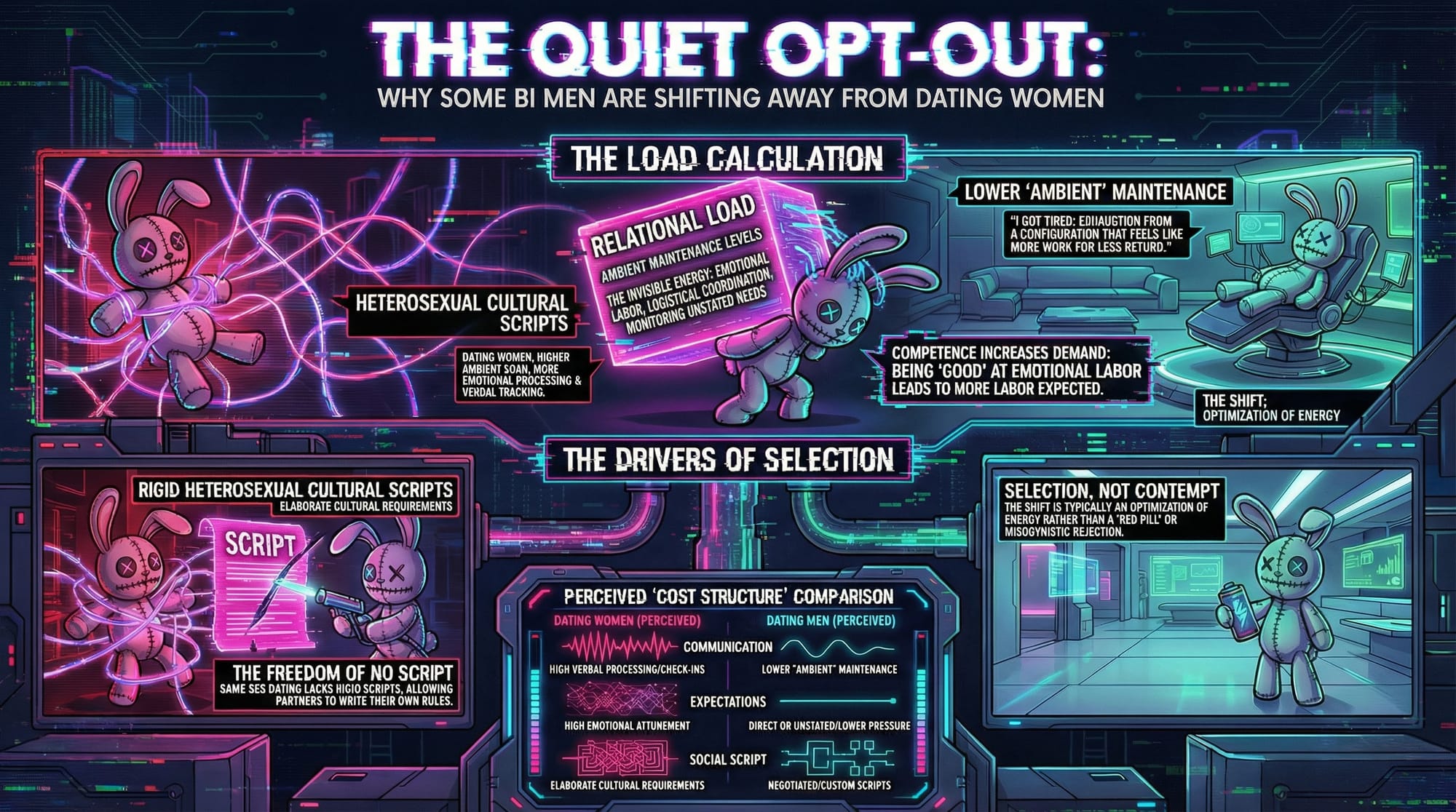
Dating men feels easier. Not without problems—men have plenty of problems—but a different cost structure. Lower ambient maintenance. Less unspoken negotiation.
He doesn't announce anything. Doesn't make a political statement. Just... gradually adjusts his dating patterns. Opens the apps with men's settings. Declines setups with women friends suggest. Drifts into configurations that fit his nervous system better.
The bi man who quietly stopped dating women.
The Load Calculation
Relational load is real. Every relationship requires maintenance—emotional labor, logistical coordination, attention, accommodation.
Different relationship configurations have different load profiles.
The experience these men describe is that dating women often carries higher ambient load. Not because women are worse—many of these men adore women, have close female friendships, aren't remotely misogynist. But the relational configuration of dating women requires more.
More processing of emotions. More verbal engagement with how things are going. More check-ins about relationship status. More accommodation of preferences. More attention to emotional temperature. More tracking of unstated needs. More labor that's invisible until it's missing.
This isn't imaginary. Research on heterosexual relationships consistently finds that women do more emotional labor—they track birthdays, manage social calendars, notice when things are off, initiate relationship conversations. But the load isn't just one direction. Men in relationships with women also experience load—the requirement to engage with this system, to participate in the emotional processing, to show up for conversations about how things are going.
Dating men can have its own labor. Men have problems. Men can be emotionally unavailable, avoidant, poor communicators. The labor profile is different, not absent. But the ambient maintenance level often feels lower to these bi men.
The man-man relationship they describe has less required processing. Less expectation of ongoing conversation about relationship status. Less need to accommodate preferences that were never stated explicitly. If something's wrong, it gets said or it doesn't, but there's not ambient expectation of emotional attunement.
This isn't universal. Individual variation dominates. Some women are low-maintenance partners; some men are extremely high-maintenance. Population patterns don't predict individuals. The bi man might encounter a woman who's extremely straightforward and low-drama, or a man who's needy and requires constant validation.
But when a bi man has a choice—when he can select from multiple configurations—the load calculation influences the selection. If average load with women is higher than average load with men, and his nervous system has limited capacity for relational load, the selection pressure points toward men.
This isn't conscious calculation most of the time. It's felt sense. Dating women feels heavier. Dating men feels easier. Over time, he follows the lower-friction path. Not because he analyzed relationship data—because his nervous system pointed him toward configurations that cost less.
Competence Increases Demand
Here's a dynamic some describe:
With women, competence at emotional labor increases demand for emotional labor.
You're good at processing? Great, we'll process more. You're good at accommodating? Great, more accommodation needed. The better you are at relational maintenance, the more maintenance becomes expected.
With men, they report something different. Competence often reduces load. You handle things, things are handled, nobody expects ongoing processing about the handled things.
Again: not universal. Individual relationships vary enormously. But the pattern appears in enough accounts to be notable.
The man who's good at emotional labor finds that skill extracted more completely in relationships with women. The same skill, with men, results in smoother functioning rather than expanded expectations.
Not Contempt—Selection
The bi men I'm describing aren't angry at women. They don't post red-pill content. They don't think women are the problem.
They think the configuration is the problem.
Something about the relational structure of dating women—as socially constructed, as currently practiced—costs more than it gives for their particular nervous system.
This isn't "women bad." It's "this particular configuration doesn't fit me."
They're not trying to convince anyone. Not arguing that other men should follow them. Just quietly selecting into configurations that work better.
Selection, not contempt.
What Gets Said
When bi men discuss this—in queer spaces, with trusted friends—certain themes recur:
"I feel like I can relax with men." The ambient performance level drops. Less monitoring of how partner is feeling. Less adjustment of behavior to manage reaction.
"With women, I never felt like enough." Not because she said that—often she didn't. But the configuration seemed to require more. More emotional availability. More attunement. More everything.
"There's no script with men." Heterosexual dating has elaborate cultural scripts. Who initiates. Who pays. How relationships are supposed to progress. With men, you write the script together. For some, this is easier.
"I got tired." The central theme. Not hatred—exhaustion. The relational ecology with women felt like more work for less return. Eventually he stopped investing there.
The Gender Dynamics Reading
One way to read this: these men are fleeing the emotional labor that patriarchy unfairly dumps on women.
Women have been trained to do relational maintenance. When they're in relationships, they often do more—tracking birthdays, noticing moods, managing emotional temperature, initiating difficult conversations, maintaining connection with extended family. This is documented. The "mental load" articles that circulated widely described real phenomenon.
A bi man dating women participates in this system as recipient. She does the labor; he benefits. But he also experiences it as load—he's expected to engage with her processing, respond to her emotional check-ins, participate in relationship conversations. He's not doing equal labor, but he's still doing labor.
When he dates men, nobody's been trained for this role. The labor doesn't get done, or it gets done more equitably. Neither partner was socialized to track emotional temperature. Neither was trained to initiate processing conversations. So either both partners do it (rare), or neither does (more common).
On this reading, the bi man's opt-out is fleeing responsibility. Choosing partners who expect less because he doesn't want to provide what women have been conditioned to expect. He wants the benefits of relationship—companionship, sex, intimacy—without the emotional labor that relationships with women require.
There's truth here. Part of what's being fled is the expectation structure heterosexual culture has built. Women expect men to participate in emotional processing because that's how relationships are supposed to work. Men find this expectation burdensome. Bi men can opt into configurations where the expectation doesn't exist.
This reading makes the opt-out look like avoidance. Like choosing the easier path instead of doing the work. Like men once again avoiding the emotional labor that women have to do.
The Other Reading
Another way to read this: women have been conditioned to require relational labor that isn't actually necessary.
The processing, the checking in, the verbal engagement with relationship status—maybe some of this is genuine need and some is cultural construction. Maybe women have been taught that relationships should look a certain way, feel a certain way, require a certain kind of maintenance.
On this reading, the bi man isn't fleeing responsibility. He's fleeing constructed requirements that don't serve the actual relationship.
There's truth here too. Not all relational labor is necessary. Some is cultural expectation mistaken for need.
Both Are True
Both readings are probably true.
Some men are fleeing genuine responsibility they should be taking.
Some are fleeing constructed expectations nobody actually needs.
The bi man can't easily distinguish which is which. He just knows the configuration costs more than it returns. The internal calculation points toward different configurations.
Whether that calculation reflects his avoidance of legitimate labor or his reasonable assessment of unnecessary construction—he often can't say. Both are possible. Both are probably present.
Adulthood
Here's where we land:
Quietly choosing configurations that fit your nervous system is just adulthood.
The bi man who dates less women isn't making a political statement. He's not joining a movement. He's not trying to convince other men. He's not publishing manifestos about why everyone should follow his path.
He's a person with options, selecting among those options based on what actually works for his life. This is what options are for. This is what sexual orientation flexibility provides—the ability to choose configurations based on fit rather than being locked into one path.
Some configurations cost more than they give. Some relational ecologies don't fit certain nervous systems. Some people discover that the thing they were supposed to want doesn't actually work for them.
The heterosexual man doesn't have this option. He might also find relationships with women costly, exhausting, requiring more than he can sustain—but he doesn't have another option. He's attracted to women. He either figures out how to make it work or he opts out of relationships entirely.
The bi man has another option. He can redirect. He can follow the path that costs less and still get intimacy, companionship, sex, partnership. Why wouldn't he?
This is allowed. This is fine. This is adulthood.
Adults make choices based on what works for their actual life, not what they're supposed to want. Adults assess costs and benefits and select accordingly. Adults recognize that not all good things are equally good for them specifically, and some paths that work well for others don't work for them.
The bi man selecting away from dating women isn't a crisis. It's not a trend that needs intervention. It's not evidence that something's broken (though it might be—we'll get to that). It's adults making adult choices about what configurations fit their lives.
Some people will judge this as taking the easy path. As avoiding the work. As fleeing responsibility. Those judgments might be right in specific cases. The individual bi man might be avoiding legitimate work he should do.
But as general phenomenon? As pattern? Choosing configurations that work better for you isn't moral failure. It's optimization. It's what having options is for.
The Inversion
The series roasted toxic masculinity. Men behaving badly.
This ending is different. Men opting out quietly. Not angrily, not ideologically, not publicly. Just... shifting configurations.
It's not the opposite of toxic masculinity. It's orthogonal. A different axis entirely.
The dick pic sender can't model female psychology. The bi man opting out understands it fine—and finds that understanding expensive.
The sigma male can't connect and calls that philosophy. The bi man opting out can connect—and selects where.
The incel rages at exclusion. The bi man opting out isn't excluded—he's selecting.
This is the exit some men are taking. Not with anger. Not with argument. With quiet reallocation of attention and energy.
The relational ecology shifted. Some men shifted with it.