Attachment Styles and Kink Selection

Part 34 of 36 in the The 2026 Kink Field Guide series.
Throughout this guide, we've noted how attachment styles interact with specific kinks. Now let's pull those threads together.
Attachment theory describes how early experiences with caregivers shape our patterns of relating: how we handle closeness, how we respond to separation, what we expect from relationships, what triggers our anxiety or avoidance.
These patterns don't stop at the bedroom door. They shape what we want sexually, what we fear, what we find arousing, what we seek from kink dynamics. The nervous system that learned about safety and danger in infancy brings those lessons to erotic life.
This isn't determinism—attachment styles don't dictate kinks. But the correlations are interesting enough to map.
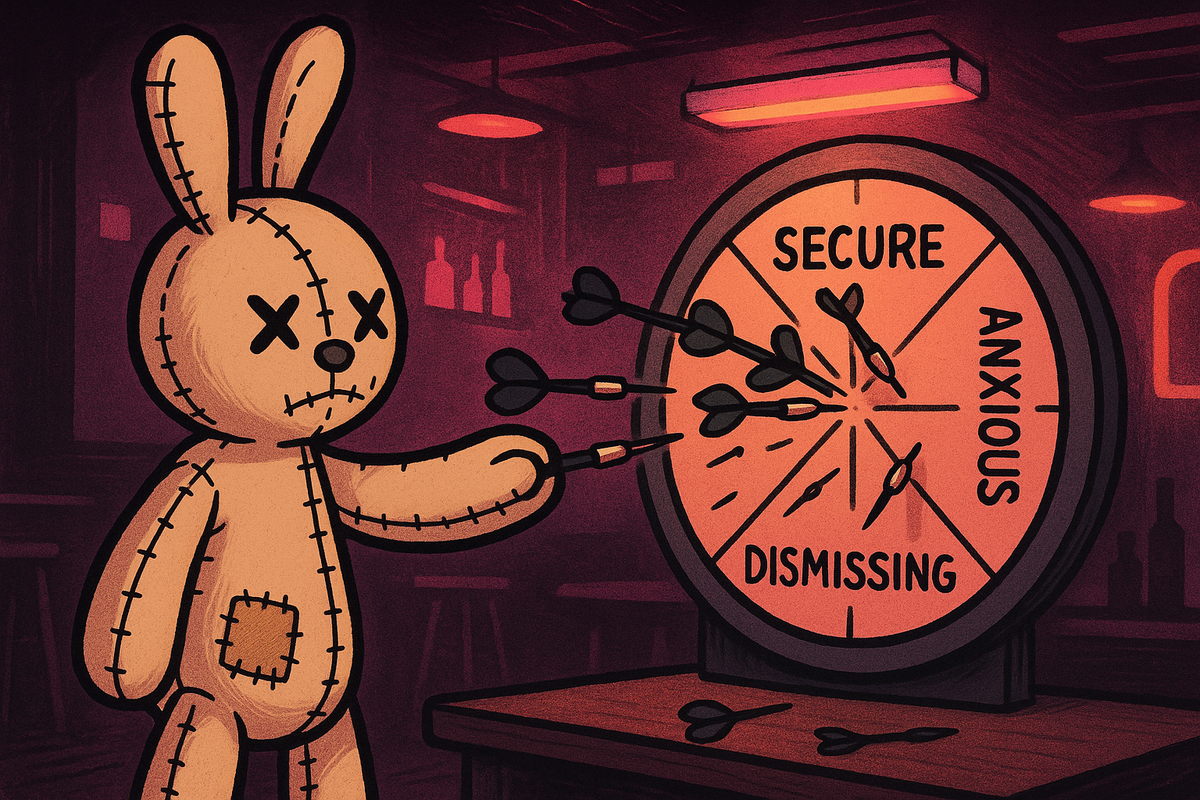
The Four Styles
Quick review of attachment styles:
Secure attachment. Comfortable with intimacy. Can depend on others and have others depend on them. Relationships feel manageable. Relatively rare—maybe 50% of the population, less in clinical contexts.
Anxious attachment (preoccupied). Craves closeness but fears abandonment. Needs reassurance. Prone to jealousy and worry about relationship stability. Maybe 20% of the population.
Avoidant attachment (dismissive). Values independence. Uncomfortable with closeness. Minimizes emotional needs. Pulls away when things get intimate. Maybe 25% of the population.
Disorganized attachment (fearful-avoidant). Both wants and fears closeness. Approach-avoid pattern. Often associated with trauma. Maybe 5% of the population, more in clinical contexts.
These are spectrums, not boxes. Most people have tendencies rather than pure types. Styles can shift across relationships and change over time.
Anxious Attachment and Kink
The anxious system craves reassurance, fears abandonment, and seeks proof of love.
Kinks that often appeal:
Praise kink. The external validation that the anxious system craves. "Good girl" provides the reassurance that you're okay, you're loved, you haven't ruined everything.
Intensity and claimed dynamics. Being claimed, possessed, owned. The intensity that finally feels like enough. The anxious person often feels that normal intimacy isn't sufficient; kink provides the volume that registers.
Breeding kink. The ultimate claiming—biologically bound together. If I have your baby, you can't leave. The permanence addresses abandonment fear.
Service submission. Being needed. Having clear ways to please. The anxious submissive can earn security through service.
Jealousy play. Cuckolding and related dynamics. The anxious person's jealousy is already intense; eroticizing it can be a way to manage it. Or it can be triggering—anxious attachment is complicated with cuckolding.
The pattern: Anxious attachment often gravitates toward kinks that provide reassurance, claiming, or intensity high enough to pierce the anxiety.
The risk: Using kink to manage anxiety can become compulsive. The kink provides temporary relief; the anxiety returns; more intense kink is sought. The escalation can become problematic.
Avoidant Attachment and Kink
The avoidant system values independence, is uncomfortable with closeness, and maintains distance.
Kinks that often appeal:
Control-based dynamics. Dominance that maintains control. If you're in charge, you're less vulnerable. The dominant position protects against the intimacy that threatens avoidants.
Primal play. Physical intensity that's not emotional intimacy. The body can engage without the heart being exposed.
Objectification. Being or treating someone as an object reduces emotional complexity. The transaction is physical; emotions don't enter.
Free use. Sexual access without emotional negotiation. The avoidant doesn't have to be emotionally present; the body is available, the self is protected.
Scene-based rather than 24/7. Clear boundaries around kink. It happens in scenes; then normal (distanced) life resumes. The container keeps the intimacy contained.
The pattern: Avoidant attachment often gravitates toward kinks that allow physical intensity while protecting emotional exposure. Control, distance, physical focus.
The risk: Using kink to avoid intimacy rather than approach it differently. The avoidant might find kink that lets them engage sexually while remaining emotionally unavailable—useful as a coping strategy, limiting as a pattern.
Secure Attachment and Kink
The secure system is comfortable with intimacy and independence. They don't need kink to solve attachment problems.
Kinks that often appeal:
Whatever actually interests them. Secure people can explore kink without the exploration being driven by attachment wounds. They might be into anything—or nothing—based on genuine interest rather than compensation.
Playful dynamics. Kink as play rather than need. The security in the relationship allows experimentation without the experiment threatening the bond.
Flexible role-switching. Can be dominant sometimes, submissive others. Not locked into one role to manage attachment anxiety.
Integration of kink and vanilla. Can do intense kink scenes and also have tender vanilla intimacy. Not either/or.
The pattern: Secure attachment allows kink to be one color in a palette rather than the whole picture. The kink serves pleasure, not attachment repair.
The question: Why is this person in kink? For secure people, it's likely genuine interest. For insecurely attached people, it might be interest plus attachment management. Both are valid, but the self-awareness matters.
Disorganized Attachment and Kink
The disorganized system both wants and fears closeness. Approach-avoid patterns. Often trauma-rooted.
Kinks that often appeal:
Edge kinks. CNC, primal play, intense dynamics. The intensity feels familiar—the disorganized person's early life was probably intense in ways that weren't safe.
Trauma-adjacent content. Dynamics that echo traumatic experiences, potentially as processing or repetition compulsion. This is territory that requires careful navigation.
Unpredictable dynamics. The disorganized person might gravitate toward partners and dynamics that replicate early chaos—intensity, unpredictability, the alternation of fear and connection.
Any and all, inconsistently. The disorganized person might cycle through different kink interests, different roles, different dynamics. The inconsistency reflects the internal disorganization.
The pattern: Disorganized attachment brings chaotic patterns to kink. The person might seek intensity that recreates familiar chaos, or might use kink to process trauma (consciously or not).
The risk: Highest. Disorganized attachment plus kink can be healing or retraumatizing. The difference often lies in the presence of therapeutic support, self-awareness, and partners who can hold complexity.
The Mapping
A tentative map (not absolute, not universal):
| Kink | Anxious | Avoidant | Secure | Disorganized |
|---|---|---|---|---|
| Praise kink | Strong pull | Less interest | Enjoys if into it | May need intensely |
| Humiliation | Can work but risky | Less interest | Enjoys if into it | Complex relationship |
| Control/dominance | Mixed | Strong pull | Either role | Variable |
| Service submission | Strong pull | Less interest | Either role | Variable |
| Primal | Mixed | Strong pull | Enjoys if into it | Strong pull |
| CNC | Complex | Can work | Requires security | Complex, risky |
| Breeding | Strong pull | Less interest | Enjoys if into it | Strong pull |
| Cuckolding | Complex | Mixed | Requires security | Complex, risky |
| Objectification | Mixed | Strong pull | Either role | Variable |
This map is suggestive, not predictive. Any attachment style can engage with any kink. The question is what's driving the engagement.
The Therapeutic Question
Is kink therapeutic for attachment wounds?
The optimistic view: Kink can provide corrective emotional experiences. The securely attached dominant can provide the stability the anxiously attached submissive never had. Consensual power exchange can repair wounds from non-consensual power experiences. Kink as healing.
The cautionary view: Kink can entrench patterns rather than healing them. The anxious person gets temporary relief from praise kink but doesn't develop internal security. The avoidant uses kink to maintain distance without growth. Kink as management, not cure.
The honest view: Both are true. Kink can be therapeutic, and kink can be entrenching. The difference lies in:
- Awareness. Does the person know what attachment pattern is in play?
- Integration. Is kink part of broader growth, or is it isolated?
- Partner quality. Are partners capable of providing corrective experiences?
- Professional support. Is there a therapist involved who understands both attachment and kink?
Kink without awareness is likely to repeat patterns. Kink with awareness can potentially transform them.
The Partner Question
Attachment styles interact between partners.
Anxious-avoidant pairing. Very common—the anxious pursues, the avoidant withdraws, creating a complementary (if painful) dynamic. In kink, this might show as anxious submissive with avoidant dominant. He provides just enough to keep her seeking. She provides intensity he can manage because he controls the terms.
Anxious-anxious pairing. Intense, potentially overwhelming. Both need reassurance; neither can fully provide it. In kink, might create escalating intensity as both seek "enough."
Avoidant-avoidant pairing. Distance maintained. Kink might be the only space where intimacy is allowed—contained and controlled.
Secure-insecure pairing. Potential for earned security. The secure partner can model and provide stability. In kink, the secure partner can hold the insecure partner's exploration safely. This is the pairing most likely to be healing—if the secure partner has the capacity.
Disorganized with anyone. Complicated. The disorganized pattern disrupts whatever dynamic is attempted. Requires a partner with significant capacity and probably professional support.
The Growth Question
Can attachment styles change through kink?
The concept of "earned security"—moving from insecure to secure attachment through relationship experiences—is established in attachment theory. Usually this happens through therapeutic relationships or long-term partnerships with secure partners.
Could kink contribute to earned security?
Possible mechanisms:
Corrective experience. The anxious person experiences consistent responsiveness from a secure dominant. Over time, the nervous system learns that needs will be met.
Contained vulnerability. The avoidant person experiences vulnerability in kink that doesn't result in disaster. Slowly, vulnerability becomes less threatening.
Embodied regulation. Kink involves intense states followed by aftercare. This cycle can train the nervous system in regulation—intense activation followed by co-regulated return to baseline.
Trust building. Successful kink requires trust. Repeated positive trust experiences can build attachment security.
Possible obstacles:
Kink as avoidance. Using kink to manage without growing. Getting the hit without doing the work.
Pattern reinforcement. Finding partners who replicate old patterns rather than provide corrective experience.
Lack of integration. Kink experiences stay siloed. The security experienced in kink doesn't generalize to non-kink life.
The potential exists. The outcome depends on how kink is used and with whom.
Self-Inquiry
Questions for examining your own attachment-kink relationship:
What am I seeking from kink? Pleasure? Validation? Safety? Control? Escape? The answer might point to attachment dynamics.
What does my nervous system do in kink? Does it settle? Escalate? Vacillate? The response pattern is informative.
How do I relate to kink partners? Do I idealize, then devalue? Do I distance? Do I cling? These are attachment patterns playing out.
What happens when kink goes wrong? A missed cue, a boundary crossed, a disappointment. Your response reveals your attachment style.
Is kink making me more secure or keeping me stuck? Over time, are you building internal stability, or are you dependent on external kink to feel okay?
What would change if I couldn't do kink? If kink were removed, what would you have to face? What is kink managing?
Attachment styles don't determine kinks, but they shape the relationship to kink—what draws you, what threatens you, what you're seeking, whether kink heals or entrenches.
Knowing your attachment style doesn't tell you what kinks to have. It tells you why certain kinks might appeal and what to watch for as you engage them.
The goal isn't to pathologize kink or reduce it to attachment dynamics. It's to add a layer of self-understanding to practice. With awareness, kink can be part of growth toward security. Without awareness, kink might be one more place where old patterns play out unexamined.
Previous: Kink as Identity: Hobby Community Chosen Family and Representation Next: The Evolutionary Psychology of Kink