
AI Is the New Oil But the Power Isnt Where You Think
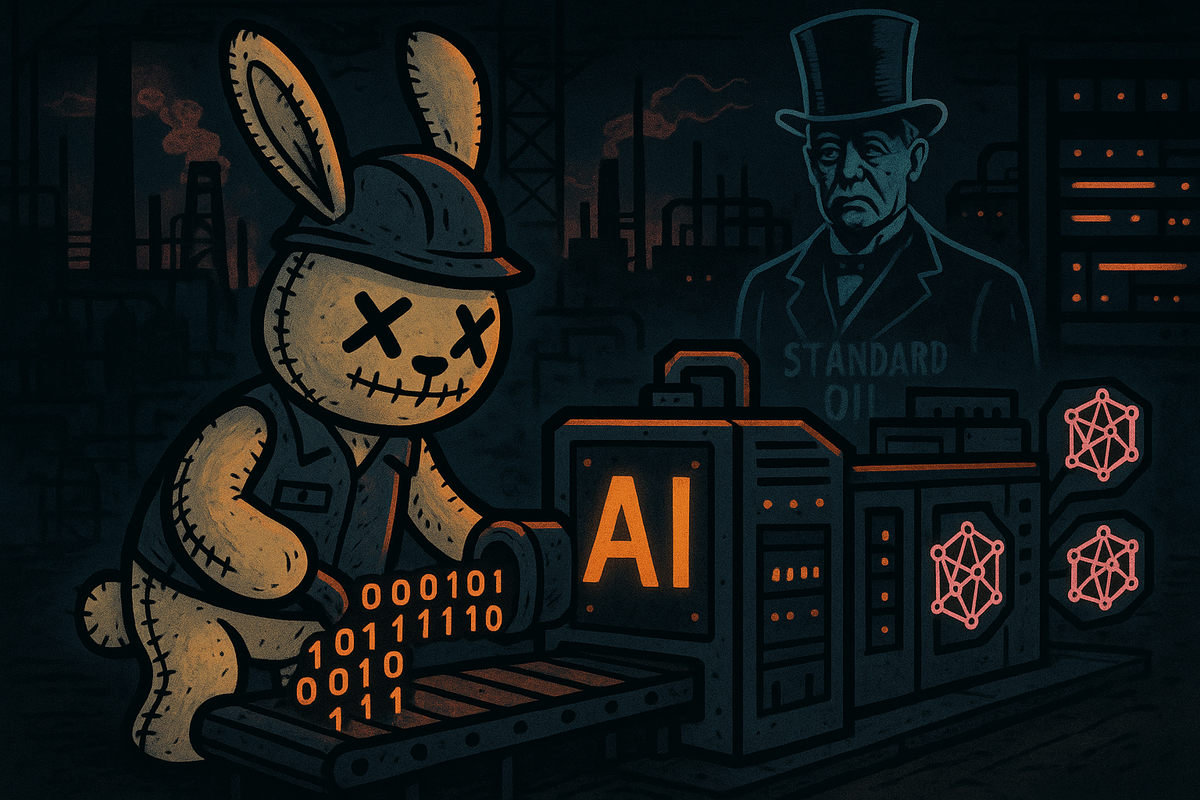
The oil analogy for AI is right, just not where people apply it. The power isn't in who owns the data — it's in who can refine it at scale.

Part 20 of 25 in the The Philosophy of Future Inevitability series.
"Data is the new oil."
Everyone says this. They mean: data is valuable. Data is strategic. Data is worth fighting over.
But they're missing the actual lesson of oil.
Oil is worthless until you can refine it. The refineries mattered more than the wells.
The Refinery Lesson
In the 19th century, people found oil all over. Pennsylvania. Texas. Russia. Baku. Lots of oil.
The oil in the ground wasn't worth much. Black goo. Useless without processing.
Rockefeller understood this. Standard Oil didn't focus on wells. It focused on refineries. It controlled the process that turned crude into kerosene and gasoline.
The producers fought each other. The refiner set the terms.
Whoever controls the transformation controls the value.
The pattern was clear if you looked. Oil producers were numerous, competitive, price-takers. They found oil, they pumped it, they sold it to whoever would buy. The market for crude was brutal. Oversupply crashed prices. Undersupply meant you couldn't deliver. The producers had no leverage.
Rockefeller saw this. Instead of drilling for oil, he built refineries. Then he built more refineries. Then he negotiated preferential rates with railroads because he controlled enough volume to matter. Then he used his refining capacity to dictate terms to producers: sell to Standard Oil at Standard Oil's price, or watch your crude sit worthless in the ground.
The producers needed the refineries more than the refineries needed any individual producer. There was always another well. There weren't other refineries at scale.
The lesson isn't "be like Rockefeller." The lesson is: in any resource economy, control the transformation layer. The raw material is abundant. The refinement is scarce. Scarcity captures value.
This pattern repeats. It's not specific to oil. It's a general principle of industrial organization. Whoever controls the bottleneck controls the economics.
The question for any new resource: where's the bottleneck? Where's the transformation that's harder to replicate than the raw extraction?
For AI, that's not the data. That's the models.
The AI Parallel
Today, data is everywhere. Every company has data. Every interaction generates data. We're drowning in data.
Data is the crude oil.
AI models are the refineries.
OpenAI, Anthropic, Google—these are the new Standard Oils. They take raw data and transform it into useful capability. The value isn't in the data; it's in the transformation.
This is why the companies are worth what they're worth. Not because they have data—everyone has data. Because they can refine it.
The Infrastructure Layer
Refineries require infrastructure. Oil refineries need: raw material supply, energy, transportation, expertise, regulation management, continuous capital investment.
AI refineries need: training data, compute, distribution, research talent, regulatory navigation, continuous capital investment.
The parallels are striking.
And like oil refineries, AI refineries have massive economies of scale. Building a refinery is expensive. Running it is relatively cheap per unit. The tenth gallon costs almost nothing. The first cost billions.
This is why AI concentrates. The economics demand scale.
Look at what it takes to train a frontier model. You need tens of thousands of GPUs. You need data centers with megawatts of power capacity. You need cooling systems. You need redundancy. You need the expertise to orchestrate distributed training across thousands of machines. You need the data pipelines to feed training at the required rate. You need the research team that understands how to tune hyperparameters at scale.
The capital cost to build this infrastructure runs into billions. Not millions—billions.
Once you have it, the marginal cost of inference is low. Running a query costs fractions of a cent. But building the refinery that makes inference possible costs more than most companies will ever be worth.
This creates a moat. Not an eternal moat—technology shifts, new architectures emerge, advantages erode. But a moat that lasts long enough to matter. The companies that built refineries early have years of advantage over anyone trying to catch up.
The advantage compounds. The revenue from the refinery funds more research, which improves the refinery, which generates more revenue. The loop reinforces. The gap widens.
You see this playing out now. OpenAI, Anthropic, Google, Meta—these are the refineries. Everyone else is either using their APIs (buying refined product) or trying to build their own refinery (hard, expensive, often failing).
The companies that thought they could compete by having "better data" are learning the lesson oil producers learned: data is crude. It's abundant. Every company has data. That's not the constraint.
The constraint is refining it. Turning raw data into useful capability. That requires infrastructure at scale that most companies can't build and most investors won't fund.
The Geopolitical Stakes
Oil determined twentieth-century geopolitics. Who had it. Who controlled shipping lanes. Who could refine it. Who could deny it.
World wars were fought over oil access. The Middle East was shaped by oil. American foreign policy was driven by oil.
AI will determine twenty-first-century geopolitics.
Who has training data. Who has compute. Who has talent. Who controls the models. Who can deny access.
The game is already being played. We just haven't named it correctly.
Consider what oil meant strategically. Japan attacked Pearl Harbor partly because the US embargoed oil. Germany's eastern campaign was partly about securing Romanian and Caucasian oil fields. The entire postwar order was shaped by who controlled oil and who depended on it for survival.
Oil wasn't just an economic asset. It was strategic capability. Militaries ran on oil. Economies ran on oil. Deny a country oil, you cripple them. Control oil globally, you control geopolitics.
AI is becoming the same kind of asset.
A country without frontier AI capability can't compete economically. Their industries will be outpaced by countries with AI. Their military will be outmatched by AI-augmented forces. Their intelligence services will be blind compared to AI-enhanced surveillance.
This isn't speculative. It's obvious to anyone paying attention. Which is why the US is restricting chip exports to China. Why China is investing hundreds of billions in domestic AI capability. Why the EU is trying to build sovereign AI infrastructure.
The chip export controls are the modern equivalent of oil embargoes. Deny China access to cutting-edge GPUs, you slow their AI development. You maintain American advantage. You prevent them from building refineries at the same scale.
This is economic warfare. It's being conducted through trade policy and export controls, but it's warfare. The goal is maintaining strategic advantage in the technology that will define this century.
China knows this. They're not fighting the chip controls through diplomacy. They're racing to build domestic alternatives. To create refining capacity that doesn't depend on American hardware. To achieve AI sovereignty.
The countries that win this race will set terms for the countries that lose. Not through military conquest—through economic dependency. The same way oil dependency shaped the 20th century, AI dependency will shape the 21st.
The Compute Bottleneck
Oil's bottleneck was refining capacity.
AI's bottleneck is compute.
Training frontier models requires enormous computing resources. GPUs. Data centers. Power. The compute is finite. It's concentrated. It's strategic.
NVIDIA isn't just a chip company. It's the refining equipment manufacturer. The companies that control compute are the companies that control AI.
This is why the GPU shortage mattered. This is why data centers are being built at frantic pace. This is why power consumption is becoming a strategic concern.
The crude is available. The refining capacity isn't.
The Energy Connection
The metaphor becomes literal: AI requires enormous energy.
Training a large model consumes as much power as small countries use in a year. Inference—running the models—adds more. Data centers are becoming significant portions of grid demand.
AI doesn't just parallel oil. AI requires energy at scale.
This creates interesting loops. AI improving energy efficiency. Energy abundance enabling more AI. The two resources intertwined.
The twentieth century ran on cheap energy. The twenty-first might require even more.
The Access Question
Oil was weaponized. Embargoes. Sanctions. Supply manipulation. If you couldn't access oil, your economy stopped.
AI can be weaponized the same way.
Deny a country compute, they can't train models. Cut off API access, their companies can't compete. Control the refineries, control the world.
This is why AI sovereignty is becoming national security. This is why governments are investing in domestic capabilities. This is why the export controls on chips are strategic, not commercial.
The OPEC of AI hasn't formed yet. But the conditions for it exist.
The Standard Oil Ending
Standard Oil got broken up. Antitrust. Too much power concentrated in too few hands.
Will the AI refineries face the same? The power concentration is similar. The strategic importance is higher. The regulatory challenge is greater—AI crosses borders in ways oil never did.
Maybe they get broken up. Maybe they become regulated utilities. Maybe they become so integrated with government that they're effectively nationalized without the name.
Or maybe they win and the concentration becomes permanent. Rockefeller didn't lose because he had to lose. He lost because political will formed against him. That will might not form here—or might form too late.
The Standard Oil breakup happened because the concentration became politically intolerable. Rockefeller controlled 90% of US refining. The power was too visible, too obviously monopolistic. Progressive movement built momentum. Teddy Roosevelt made trust-busting central to his presidency. The Supreme Court ruled in 1911.
But notice: this took decades. Standard Oil was founded in 1870. It was broken up in 1911. Forty-one years of dominance before the political system responded.
The AI refineries have been dominant for less than five years. The concentration is already extreme—OpenAI, Anthropic, Google, and Meta control the vast majority of frontier capability. But the political will to break them up doesn't exist yet.
It might not form at all. The strategic value of having dominant AI companies is higher than the strategic value of oil companies was. Breaking up your own AI champions while China is building theirs would be strategic suicide. National security concerns might outweigh antitrust concerns.
Alternatively, the integration with government becomes total. The AI companies become de facto extensions of intelligence and military apparatus. They're too important to break up, too strategic to leave fully private, too useful to regulate heavily. They end up in a weird liminal space—technically private, functionally governmental.
Or the technology shifts and makes the current refineries obsolete. New architectures emerge. New companies leapfrog the incumbents. The concentration breaks not through regulation but through innovation. This is possible. It's also not guaranteed.
The most likely outcome might be something we don't have good language for yet. Hybrid entities that are part company, part utility, part strategic asset. Regulated but protected. Profitable but constrained. Private but serving public function.
What seems unlikely is that they get broken up the way Standard Oil was. The world is different. The strategic stakes are higher. The timeline for political response is slower than the timeline for technological entrenchment.
By the time political will forms, the concentration might be too deep to reverse.
The Investor Insight
The refineries are where the value concentrates.
Rockefeller understood this before others. He bought refineries while others chased wells.
In AI: the models, not the data. The compute, not the content. The transformation layer, not the raw material.
Invest accordingly.
The National Strategy
If you're a nation-state, the lesson is clear:
You need refining capacity. Domestic AI capability. Compute sovereignty. The ability to transform your data into useful AI without depending on foreign refineries.
Japan learned this about oil the hard way. Germany learned it. Resource dependency creates strategic vulnerability.
AI dependency will be the same.
The new oil isn't data. The new oil is the refining capacity—the ability to turn data into intelligence.
Control the refineries, control the future.
Previous: Delve: How AI Broke the English Language Next: China Chips and the Refinery Wars